
At a meeting with chairmen and managing directors of public sector banks, Chidambaram asked them not to overprice loans to FMCG and automobile sectors.
The Bank Rate (6%), Repo Rate (7.75%) and Reverse Repo Rate (6%) have all been left unchanged in the half-yearly review of the monetary policy on Tuesday.
The banking industry could witness another round of prime lending rate hikes beginning next week, a top Indian Banks' Association official said on Wednesday.
Concerned over surging inflation, Reserve Bank of India hiked the short-term repo rate on Wednesday by 0.25 per cent to 7.50 per cent while keeping reverse repo, bank rate and cash reserve ratio unchanged.
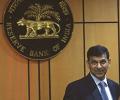
Reserve Bank of India Governor Yag Venugopal Reddy presents the First Quarter Review of Annual Statement on Monetary Policy for the Year 2006-07.
Financial services firm AnandRathi analysed the key points of the policy soon after it was announced.

The NSE Nifty slumped to a low of 4,833, and finally settled with a heavy loss of 155 points at 4,853. The index has shed 422 points (8%) in the last six day. The market breadth too was extremely bearish, with nearly eight stocks for each advancing stock. Out of 2,944 stocks traded, 2,582 declined and 337 advanced on Wednesday.
RBI will be cautious easing rates further given oil price uncertainties

At its monetary review on Tuesday, the RBI raised the statutory liquidity ratio by 1 percentage point to 25 per cent and discontinued the special repo facility for banks to provide liquidity to mutual funds and others.

The banking system neared Rs 1.47 trillion of liquidity deficit on Monday, the highest since January 29, 2020, when the banking system liquidity deficit went up to Rs 3 trillion. The Reserve Bank of India (RBI) injected Rs 1.47 trillion on Monday and Rs 1.46 trillion on Tuesday. Market participants say that the disbursement of Rs 25,000 crore as the second tranche of incremental cash reserve ratio (I-CRR) will not be enough, and the liquidity might tighten further to Rs 2 trillion in short term due to tax outflows and arrival of the festival season.
Leading industry and export chambers like PHDCCI and Federation of Indian Export Organisation on Tuesday demanded 1.0 per cent cut in bank rate and cheaper export finance in Reserve Bank of India's' forthcoming busy season credit policy.

The Reserve Bank of India on Tuesday left all the key interest rates unchanged in the first quarterly review of the monetary policy.

RBI's exercise will take into account standards of governance, the viability of the payment bank (PB) business model, and changes, if any, if needed.

Highlights of the RBI monetary policy.
The Reserve bank of India has just increased its repo rate and CRR and there are chances that banks may soon increase the interest rates on home loans.
A spiralling inflation is likely to force the Reserve Bank of India to up the Cash Reserve Ratio by 0.75 per cent in FY 09, along with a 1 per cent hike in repo and reverse repo rates, global financial services major, StanChart said.
Interest rates on fixed rate home loans have been increased by 0.75 per cent to 8.50 per cent from the current level of 7.75 per cent with effect from November 17, 2004.

Key share indices ended over 1 per cent higher on Tuesday led by rate sensitive shares as the sluggish April IIP data re-inforced market expectations that the central bank could cut key policy rates and also lower the cash reserve ratio to boost growth.
State Bank of India and ICICI Bank, two of India's largest banks, on Tuesday said that there would be no immediate hike in interest rates due to the Reserve Bank of India's decision to increase the cash reserve ratio in banks to curb inflation.
Nearly three years after the Reserve Bank of India began its move towards a soft interest rate regime, the trend is seeing a slow but sure reversal.
Planning Commission on Monday welcomed Reserve Bank of India's decision to hike cash reserve ratio by 0.5 per cent to 5 per cent saying it is the right step to suck out excess liquidity
The Reserve Bank of India has raised the cash reserve ratio of banks by 0.5 per cent to 5 per cent of their net demand and time liabilities (NDTL), in two stages beginning fortnight September 18.
As far as the Indian households are concerned, although the leverage ratio in this basket has multiplied nearly 3 times in the past decade, it is still well below not just developed but also most other developing economies.

The RBI has changed the way it approached supervision in the past. Having seen a couple of collapses in the NBFC sector and the near-collapse of a few banks, it is focusing on regular drills to prevent a fire from breaking out, explains Tamal Bandyopadhyay.
The Reserve Bank of India has left bank rate and cash reserve ratio unchanged at 6 per cent and 4.5 per cent, respectively.
The Reserve Bank of India on Tuesday cut the bank rate by 0.25 per cent to 6 per cent with effect from close of business hours.
Rising interest rates slows down the overall growth in the economy

From the Sensex pack, IndusInd Bank, NTPC, Asian Paints, Hindustan Unilever, JSW Steel, Tech Mahindra, Bajaj Finance, Infosys, Wipro, ICICI Bank, Bajaj Finserv, HDFC Bank and Tata Motors were among the major laggards. HCL Technologies, Power Grid, Titan, Reliance Industries, UltraTech Cement, Tata Steel, State Bank of India and Mahindra & Mahindra were the gainers.
Let's take a quick look at what all these terms mean to see how they affect the loan interest rates.

This is the fourth consecutive time that the RBI has kept key interest rates unchanged despite clamours from the industry to cut rates to boost economy.
The NSE Nifty ended at 3,606, up 4 points. The market breadth was fairly negative - out of 2,682 stocks traded, 1,820 declined, 789 advanced and 73 were unchanged.
The principles of central banking in Asia are likely to change. Be prepared for surprises.

The Reserve Bank of India's (RBI's) decision to withdraw the incremental cash reserve ratio (I-CRR) is expected to benefit banks during the festival season. They are likely to increase deposit rates by up to 25 basis points (bps) in select maturity buckets. The rise in demand for funds to cover tax payments and meet quarter-end business targets could influence rate decisions by banks, according to bankers and money market executives.

'If it doesn't, it will continue with measures to infuse liquidity, signalling a new cycle,' predicts Tamal Bandyopadhyay.
Country's leading housing finance company HDFC chairman Deepak Parekh said on Friday that he expects interest rates to soften by 0.25-0.50 per cent if there is no hike in the cash reserve ratio.
